

Why Breed-Specific Rescues Produce Better Adoptions
Breed-specific rescues are nonprofit organizations dedicated to a single dog breed, using deep expertise to place every dog in the right home. Unlike general shelters, these groups know exactly what a Golden Retriever, Greyhound, or Siberian Husky needs before the adoption ever happens. That focused knowledge changes everything: the match quality, the welfare outcomes, and the long-term success of the placement. If you are considering adopting a dog and want a process built around your lifestyle and your future dog’s real needs, understanding why breed-specific rescues work is the best place to start.
Why breed-specific rescues outperform general shelters
The core difference between a breed-specific rescue and a general animal shelter is specialization. General shelters house dogs of every breed and mix, often in kennel environments that create stress and mask true behavior. Breed rescues focus on one breed, run foster-based placement models, and staff volunteers who have lived with that breed for years.
That specialization shows up in every part of the adoption process. According to a detailed comparison of rescue models, general shelters use kennels while breed rescues use foster homes, and the difference in what each setting reveals about a dog is significant. A kennel shows you a stressed dog. A foster home shows you how that dog actually behaves around children, cats, and furniture.

Here is how the two models compare directly:
| Category | General Shelter | Breed-Specific Rescue |
|---|---|---|
| Dog population | Mixed breeds and purebreds | Single breed focus |
| Housing model | Kennel-based | Foster home network |
| Breed expertise | Generalist staff | Deep single-breed knowledge |
| Adoption screening | Standard application | Lifestyle and breed compatibility review |
| Post-adoption support | Minimal | Ongoing breed-specific guidance |
| Typical adoption cost | $50–$200 | $200–$500 |
The higher adoption fee at breed rescues reflects the veterinary care, behavioral assessment, and foster support built into the process. You pay more upfront because the rescue has already invested heavily in preparing that dog for your home.
Key operational advantages breed rescues hold over general shelters include:
- Volunteers who recognize breed-specific health risks before placement
- Foster families who observe real household behavior over days or weeks
- Screening questions tailored to breed energy levels and temperament
- Post-adoption helplines staffed by breed-experienced volunteers
How does breed knowledge improve adoption outcomes?
Breed knowledge is the engine behind every successful placement a breed rescue makes. A Dalmatian rescue knows that the breed needs intense daily exercise and can develop deafness. A Basset Hound rescue knows the breed is scent-driven and escape-prone. That knowledge shapes which adopters get approved and which dogs go to which homes.
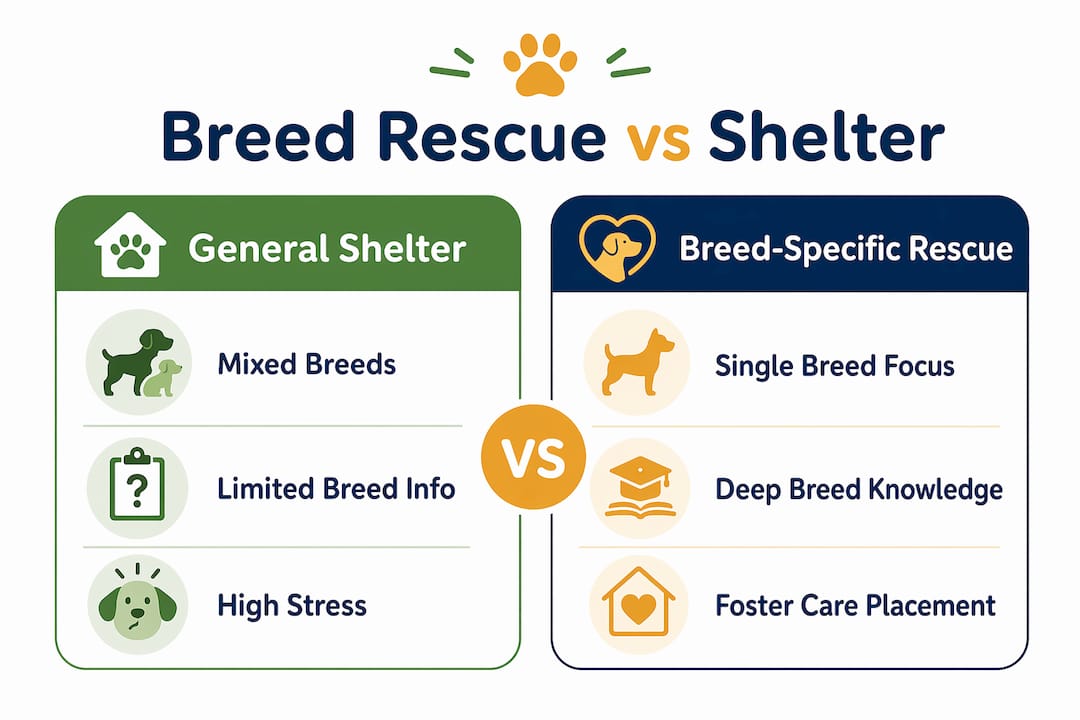
Breed temperament, health, and energy needs guide every placement decision in a breed rescue. This is not a generic checklist. It is a detailed profile built from years of working with one breed across hundreds of placements. The result is a match quality that general shelters simply cannot replicate with a mixed population and generalist staff.
The screening process in a breed rescue typically covers:
- Activity level: Does your daily routine match this breed’s exercise requirements?
- Living space: Is your yard fenced? Is your apartment large enough for a high-energy breed?
- Household composition: Are there young children, other dogs, or cats that could conflict with breed tendencies?
- Experience level: Have you owned this breed before, or do you need extra preparation?
- Long-term commitment: Are you prepared for breed-specific health costs over a 10–15 year lifespan?
Foster homes add another layer of precision to this process. Foster homes act as information amplifiers, revealing house training status, separation anxiety triggers, and breed-specific behavioral tendencies that a kennel environment suppresses entirely. A dog that appears shut down in a shelter may be playful, affectionate, and well-mannered in a foster home. That behavioral data directly improves match quality.
Animal behavior research adds an important dimension here. Early life experience between 3–14 weeks shapes a rescue dog’s social and emotional development in ways that require structured learning to address. Breed rescues understand this context. They know whether a dog missed critical socialization windows and can advise adopters on what that means for training and adjustment.
Pro Tip: Ask your breed rescue coordinator specifically what the dog did during its first week in foster care. That behavioral snapshot is more predictive of post-adoption behavior than any kennel observation.
What welfare benefits does foster care provide?
Foster care is not just a housing solution. Science confirms it is a welfare intervention with measurable effects on dog stress and behavior. A study tracking 84 shelter dogs over 17 days found that cortisol levels dropped significantly during days 7–12 of foster placement, while resting behavior increased. Lower cortisol and more rest are direct indicators of reduced stress and improved well-being.
That finding matters for adoption outcomes because a calmer dog is an easier dog to assess accurately. When stress hormones drop, the dog’s true personality emerges. Breed rescues that use foster networks are not just being kind. They are generating better behavioral data for every placement decision they make.
A common concern among potential adopters is whether returning a dog to the shelter after fostering causes psychological harm. Research shows cortisol levels do not spike post-fostering compared to pre-foster baselines. The dog does not experience a stress rebound. This finding supports the foster model as genuinely beneficial, not just a temporary fix that makes things worse when it ends.
Pro Tip: If you are considering fostering before adopting, one week is enough to see meaningful behavioral change. You will learn more about a dog in seven days of foster care than in ten shelter visits.
There is an important nuance, though. Stress reduction from fostering happens quickly, but building lasting behavioral confidence requires structured, breed-informed support after adoption. Breed rescues provide exactly that. Their post-adoption guidance is not generic. It addresses the specific behavioral patterns of the breed and the individual dog’s history.
Why choose breed-specific dogs: adopter advantages
Adopting through a breed rescue gives you a level of preparation that general adoption simply does not offer. You know the breed’s personality before you commit. You understand the health risks, the grooming demands, and the training challenges specific to that dog type. That knowledge reduces the chance of a mismatched adoption that ends in return.
Breed rescue success stories consistently share a common thread: adopters who felt genuinely supported through the process and matched with a dog whose traits fit their actual lifestyle. Organizations like the Dachshund Rescue of North America, the Labrador Retriever Rescue of Florida, and the Great Dane Rescue Alliance each specialize in one breed and build entire support networks around that breed’s specific needs.
The practical benefits of choosing a breed rescue include:
- Predictable temperament: Purebred dogs from rescues carry known behavioral tendencies, making training and integration more manageable.
- Health transparency: Breed rescues screen for common genetic conditions before placement and disclose known health histories.
- Lifestyle alignment: The screening process filters out mismatches before they become problems, protecting both the dog and the adopter.
- Ongoing community: Many breed rescues connect adopters with breed-specific Facebook groups, training resources, and volunteer networks.
- Breed preservation: Supporting a breed rescue contributes to responsible rehoming practices that keep breed populations healthy and well-placed.
Avoiding common adoption mistakes is far easier when the rescue has already done the compatibility work for you. Breed rescues reduce the guesswork that leads to returns, rehoming, and heartbreak on both sides of the adoption.
Key takeaways
Breed-specific rescues produce better adoption outcomes because they combine deep breed knowledge, foster-based behavioral assessment, and ongoing post-adoption support into a single, specialized process.
| Point | Details |
|---|---|
| Specialized breed knowledge | Rescues use single-breed expertise to match dogs with compatible adopters before placement. |
| Foster care reduces stress | Studies show cortisol drops significantly within 7–12 days of foster placement, revealing true behavior. |
| No post-foster stress rebound | Dogs do not experience higher stress after returning from foster care, validating the foster model. |
| Better screening process | Breed rescues screen adopters on lifestyle, experience, and breed compatibility, reducing return rates. |
| Post-adoption support matters | Behavioral confidence requires structured, breed-informed guidance beyond the initial adoption day. |
The part most adoption guides leave out
I have spent years watching people adopt dogs and struggle within the first three months. The pattern is almost always the same: the adopter chose a breed they loved the look of, the shelter gave them a basic handout, and nobody prepared them for what that specific dog actually needed at home.
Breed-specific rescues solve this problem at the source. What strikes me most is not the foster care science, impressive as it is. It is the institutional knowledge these organizations carry. When a Weimaraner rescue coordinator tells you that your dog will likely develop separation anxiety and gives you a protocol to prevent it before it starts, that is a level of support no general shelter can match.
The welfare research backs this up, but experienced breed rescue volunteers knew it long before the studies confirmed it. Foster homes reveal behavioral triggers, daily rhythms, and breed tendencies that kennels suppress entirely. That information is the difference between a placement that works and one that falls apart at the six-month mark.
My honest recommendation: if you have a specific breed in mind, go to the breed rescue first. Read their adoption requirements carefully. If they seem strict, that strictness is the point. It is what makes their placements stick. You can also explore the full adoption process step by step to understand what to expect before you apply.
— Taylor
Find your match through Greenfieldpups
Greenfieldpups connects dog lovers with trusted breeders and adoption resources across the United States. Whether you are exploring breed-specific adoption or researching responsible breeders, the platform gives you the tools to make an informed decision.
If you are weighing adoption against purchasing from a breeder, Greenfieldpups covers both sides of that decision with depth and honesty. Start with the guide on pet adoption benefits to understand what adoption can offer your household. For those considering a breeder, the resource on responsible dog breeding outlines what ethical breeding looks like and what questions to ask. Every dog deserves a placement that lasts. Greenfieldpups helps you get there.
FAQ
What is a breed-specific rescue?
A breed-specific rescue is a nonprofit organization that focuses exclusively on rescuing, rehabilitating, and rehoming dogs of one particular breed. These groups use specialized breed knowledge and foster home networks to improve placement quality and adoption success.
How do breed rescues screen adopters?
Breed rescues screen adopters based on lifestyle compatibility, living situation, experience with the breed, and household composition. The goal is to match each dog’s temperament and energy level with an adopter who can meet those specific needs.
Does foster care actually reduce dog stress?
Yes. A study tracking 84 shelter dogs found cortisol levels dropped measurably during days 7–12 of foster placement, with increased resting behavior confirming reduced stress. Dogs also showed no cortisol spike after returning to the shelter.
Are breed-specific rescues more expensive than shelters?
Breed rescues typically charge $200–$500 in adoption fees compared to $50–$200 at general shelters. The higher cost reflects veterinary screening, behavioral assessment, and foster care investment made before the dog reaches your home.
Can i adopt a purebred dog through a breed rescue?
Yes. Breed-specific rescues specialize in purebred dogs of one type, making them the most reliable source for adopting a known breed with documented temperament and health history outside of a licensed breeder.
Leave a Comment