


How to advertise puppies: attract buyers and build trust
Knowing how to advertise puppies sounds simple until you’re three days into posting and your inbox is full of lowball offers, suspicious requests, and zero serious inquiries. For responsible breeders, the problem isn’t finding an audience — it’s cutting through the noise to reach buyers who actually care about where their dog comes from. This guide walks you through every layer of effective puppy advertising: what credentials to build before you post, how to craft listings that earn clicks and trust, what the law requires, and how to protect both yourself and buyers from the scams that have made online pet sales one of the most fraud-prone categories on the internet.
Table of Contents
- Understanding requirements and building credibility before advertising
- Creating puppy listings that attract and engage buyers
- Ensuring legal compliance and ethical advertising practices
- Protecting buyers and building trust with safe advertising practices
- Why genuine transparency beats flashy ads in puppy marketing
- Explore expert resources and tools to enhance your puppy advertising
- Frequently asked questions
Key Takeaways
| Point | Details |
|---|---|
| Build credibility first | Meet AKC health testing and education standards to prove responsible breeding and gain buyer trust. |
| Use visual storytelling | Include clear photos, detailed headlines, and genuine videos to attract buyers effectively. |
| Comply with FTC rules | Ensure testimonials are truthful and disclose any incentives to avoid deceptive advertising. |
| Prioritize buyer safety | Offer live video verification, transparent health records, and secure payment options. |
| Transparency wins trust | Open communication and authenticity are more important than flashy ads or low prices. |
Understanding requirements and building credibility before advertising
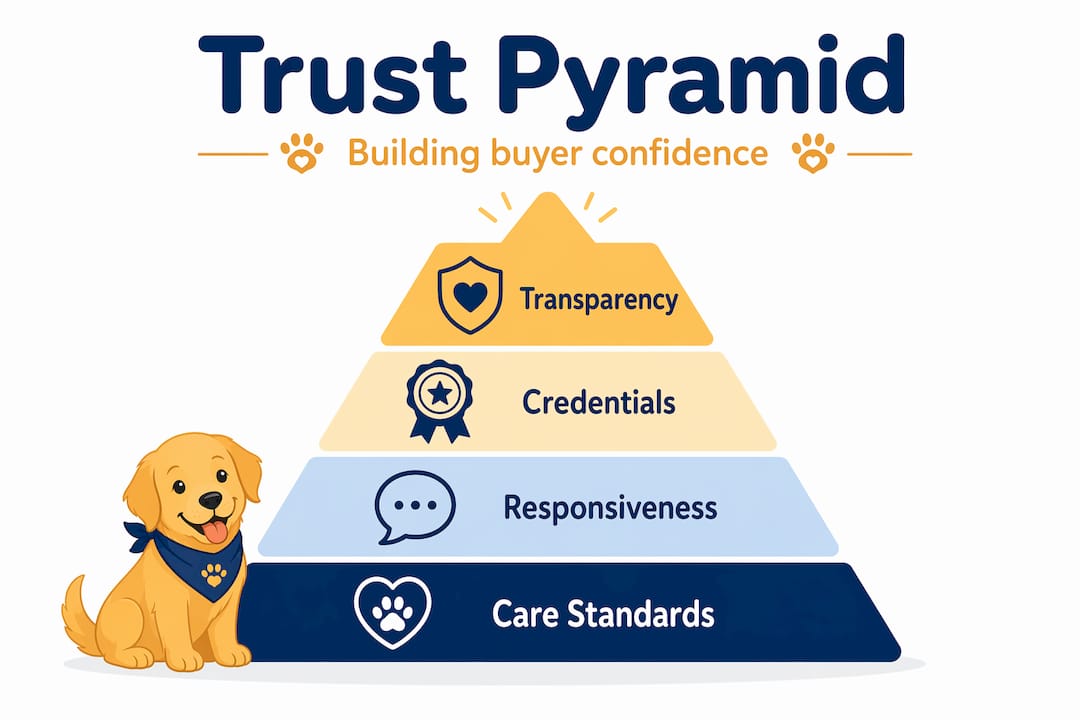
The breeders who consistently attract serious, qualified buyers share one trait: they show their work before anyone asks. That means credentials, health records, and documented compliance with established programs — not just a photo and a price tag.
The AKC Bred with H.E.A.R.T program requires breeders to commit to health testing, continuing education, and compliance with AKC care policies, giving participants a proof-backed marketing advantage that unverified sellers simply cannot match. When you display that credential in your listing, you’re not just signaling quality. You’re screening out buyers looking for the cheapest option and drawing in buyers who research before they buy.
Beyond certification, your advertising credibility rests on a few non-negotiables:
- Health testing documentation for the specific conditions common to your breed (hip scores, eye exams, genetic panels)
- Vaccination and deworming records with vet signatures and dates
- Proof of AKC or equivalent registration for both parents
- Inspection compliance showing your facility meets welfare standards
- References from previous buyers who can speak to puppy health and temperament after placement
Understanding breeder ethics and roles gives you a clearer picture of what serious buyers are now expecting from their research. Buyers in 2026 are more educated than ever, and many arrive at listings already knowing what red flags look like.
| Credential | What it proves | Buyer impact |
|---|---|---|
| AKC Bred with H.E.A.R.T | Health testing and policy compliance | High trust signal |
| OFA/PennHIP health testing | Genetic health screening | Reduces health concern |
| Vaccination records | Vet-verified care | Increases buyer confidence |
| Written health guarantee | Post-sale accountability | Reduces hesitation |
| Facility inspection record | Welfare compliance | Differentiates from mills |
Pro Tip: Before you post your first listing, compile all credentials into a single shareable document or folder. Buyers who ask for records and get them within minutes form a dramatically different impression than those who wait two days for a blurry photo of a vet card.
Adopting responsible dog breeding practices is not just ethical — it’s your most powerful marketing asset. Every standard you meet becomes a reason a buyer chooses you over a competitor with none.
Creating puppy listings that attract and engage buyers
A listing that converts a browser into a buyer does three things fast: it looks credible, it answers the questions buyers actually have, and it feels honest. Most listings fail on at least two of those counts.
Start with visuals, because buyers make their first judgment in under three seconds. High-quality photos and video with a clear headline that includes the puppy’s name, breed, and availability date dramatically improve listing performance. Use natural lighting, get down to the puppy’s level, and lead with a front-facing face shot. Multiple photos showing personality (playing, sleeping, interacting with humans) outperform single portraits.

For social media, a 30 to 60 second genuine video beats every static image. Skip the filters and the music. Show the puppy running, responding to its name, or simply being curious. Authenticity converts better than polish in this category.
Your headline and description should answer these questions without the buyer having to ask:
- Breed and mix (if applicable), with accurate coat and color descriptions
- Date available for pickup or delivery
- Price and what it includes (vaccines, microchip, registration paperwork)
- Sex, birth date, and litter size
- Parents’ health clearances and registration numbers
- Your location and whether you ship or require in-person pickup
Avoid phrases like “will make a great Christmas gift,” “first come first served,” or anything that pressures a buyer into a fast decision. Serious buyers walk away from pressure. They stay when listings feel like an open, honest conversation.
Pro Tip: End your listing description with an explicit invitation to video call. Something like “We welcome live video calls any time to show you this litter in person” tells legitimate buyers you have nothing to hide and immediately disqualifies scammers who avoid live interaction.
Your dog breeder listing guide covers platform-specific formatting that helps listings rank within search results on major marketplaces. Understanding why listing pets online works better than local-only advertising also expands your qualified buyer pool significantly. For a deeper look at what actually drives clicks and inquiries, proven dog advertising tips break down the specific elements that separate high-performing ads from ignored ones.
Ensuring legal compliance and ethical advertising practices
Most breeders advertising puppies online have no idea they’re subject to federal advertising law. But if you use testimonials, endorsements, or reviews anywhere in your marketing, the FTC is watching.
FTC endorsement guides require that endorsements be truthful, not misleading, and that any material connection between an endorser and the advertiser be clearly disclosed. That means if a buyer posts a glowing review in exchange for a discount on a future litter, you are legally required to disclose that relationship wherever the review appears.
Here is what ethical, legally sound puppy advertising looks like in practice:
- Use only real reviews from actual buyers, never fabricated or embellished quotes
- Disclose clearly if any reviewer received compensation, a discount, or another benefit
- Represent typical outcomes — if most buyers are happy but one had a health issue, do not cherry-pick only five-star experiences
- Document your substantiation — keep records of health claims, certification dates, and test results in case they are ever questioned
- Never claim a breed is “hypoallergenic” without qualification, as this is a commonly challenged advertising claim
“Advertisers are responsible for ensuring that their advertising and marketing claims are truthful, not misleading, and substantiated.” This standard applies to everything from your listing description to the Instagram caption on your puppy photos.
Your breeder ethics and responsibilities as a seller extend beyond just the puppy’s care. They include how you represent yourself and your animals in writing, on video, and in reviews. Legal compliance is not optional, and the breeders who treat it seriously are the ones buyers and platforms protect.
Protecting buyers and building trust with safe advertising practices
Online puppy fraud costs Americans millions of dollars each year, and the tactics scammers use have grown more convincing. As a legitimate breeder, understanding what scams look like helps you proactively signal safety to nervous buyers.
Watch for these red flags in any transaction, whether you’re the buyer or the seller evaluating suspicious inquiries:
- Prices far below market rate for the breed (often 40 to 60 percent lower)
- Requests for wire transfers, Zelle, Venmo, or gift cards as the only payment option
- Refusal or constant delay when asked for a live video call
- Stock photos used instead of actual litter photos
- Sob stories requiring urgent “transport fees” after initial payment
- No physical address, no verifiable references, no registration paperwork
Live video calls and vaccination proof are the two practices buyer safety experts consistently recommend to verify legitimacy. A legitimate breeder never hesitates to get on video.
Here is a practical buyer verification checklist before any payment changes hands:
- Request a live video call showing the puppy with the breeder on screen together
- Ask to see the original vet records (not a scan of a scan)
- Verify the breeder’s name and facility on AKC’s online registry or equivalent
- Check the seller’s reputation on the Better Business Bureau website
- Confirm a written contract covering health guarantees, return policy, and care requirements
- Pay only via traceable methods (credit card or PayPal with buyer protection)
Pro Tip: If a deal ever triggers a gut feeling of “something’s off,” that instinct is usually right. Scam operations are built to create urgency and emotional attachment before doubt can set in. Slow down, and any legitimate breeder will wait.
“Legitimate breeders understand that buyers are cautious and welcome verification as part of a healthy, trusting sales process.”
For buyers using safe dog marketplaces, verified listings add an additional layer of protection. Knowing how to find reputable breeders step by step makes the whole process faster and far less stressful.
Why genuine transparency beats flashy ads in puppy marketing
Here is the perspective that most puppy advertising guides skip: the breeders with the most professional websites, the lowest prices, and the most polished Instagram feeds are not always the ones buyers end up trusting. In fact, over-produced marketing in the puppy space has become its own red flag.
Buyers in 2026 are specifically looking for imperfection as proof of authenticity. A slightly shaky phone video of a wriggling litter of golden retrievers on a living room floor converts better than a cinematically lit drone shot of a manicured facility. Because the first looks real, and the second looks like a production.
Scam avoidance research consistently shows that willingness to engage live and responsively is the single clearest indicator of legitimacy. Breeders who answer within the hour, who offer video calls without being asked, and who provide documentation before it’s requested have a structural trust advantage that no amount of ad spend can replicate.
The uncomfortable truth is that many breeders invest in better photos when they should be investing in faster responses. A blurry photo with a same-hour reply will always outperform a professional portrait with a two-day silence.
Educated buyers increasingly cross-reference credentials between listing details and dog advertising strategies that signal verified breeders. They check how reputable breeders operate before they reach out. By the time they contact you, they’ve already done homework. Your job is to confirm what they hoped to find, not convince them with clever copy.
Authenticity is the strategy. Everything else is just execution.
Explore expert resources and tools to enhance your puppy advertising
Ready to put all of this into action? Greenfield Pups has built a library of resources specifically for breeders and buyers navigating the U.S. puppy marketplace.
Start with the dog breeder listing guide to understand exactly how to position your listings for maximum visibility on top platforms. If you want to understand the full scope of what ethical breeding looks like from both a legal and practical standpoint, the breeder ethics and responsibilities guide covers it in depth. And if you’re a buyer researching your options, the safe dog marketplaces guide walks you through every step of a safe, confident purchase. With these tools, you’re equipped to advertise puppies or find them with confidence, clarity, and zero guesswork.
Frequently asked questions
What are the key requirements for breeders to advertise puppies responsibly?
Breeders should meet AKC health testing and education requirements, provide complete health records, and comply with AKC care policies as a foundation for responsible advertising.
How can buyers spot puppy scams in online ads?
Watch for unusually low prices and wire payment requests, refusal of live video calls, and missing medical records — these are the most consistent red flags in fraudulent puppy listings.
Are breeder testimonials allowed in puppy advertisements?
Yes, but all testimonials must be truthful and accurately represent typical buyer experiences, and any incentive or relationship must be clearly disclosed per FTC rules.
What should a responsible puppy advertisement include to build buyer trust?
A strong listing includes clear, authentic photos, detailed breed and health information, pedigree documentation, and an explicit offer for live video verification before any commitment is made.
How important is meeting the breeder or seeing the puppy live in advertising?
Very important. Live video verification is one of the most reliable ways to confirm the puppy and breeder are real, reducing scam risk substantially for both first-time and experienced buyers.
Leave a Comment