

How to Communicate With Pet Adopters Effectively
Effective communication with pet adopters is the single most important skill shelter staff and volunteers can develop to increase successful placements and reduce returns. Knowing how to communicate with pet adopters means shifting from a screening mindset to a welcoming, conversation-based approach that builds trust from the first interaction. Resources from HumanePro, ASPCApro, and the Animal Farm Foundation all point to the same conclusion: adopters who feel heard and supported are far more likely to complete the process and stay connected with your shelter long after the adoption is finalized.
How to communicate with pet adopters using open-ended questions
The most effective way to engage adopters deeply is to replace yes/no questions with open-ended prompts. Open-ended questions invite adopters to share their lifestyle, expectations, and concerns without feeling interrogated. That shift alone changes the entire tone of an adoption conversation.
Conversational adoption approaches rely on question starters like “how,” “tell me,” “what,” and “when” rather than “why.” The word “why” puts people on the defensive immediately. “Why do you want a dog?” sounds like a challenge. “What does a typical day look like in your home?” sounds like genuine curiosity.
Here are examples of the shift in practice:
- Instead of: “Do you have a yard?” Ask: “Tell me about your outdoor space and how you imagine using it with a pet.”
- Instead of: “Have you owned a dog before?” Ask: “What has your experience been with pets in the past?”
- Instead of: “Why do you want to adopt?” Ask: “What made you decide now was the right time to bring a pet home?”
- Instead of: “Do you work long hours?” Ask: “Walk me through a typical weekday for your household.”
Each reframed question opens a door rather than closing one. Adopters share more, staff learn more, and the conversation moves toward a match rather than a verdict.
Pro Tip: Run a 15-minute role-play session at your next staff meeting. Have one person play a nervous first-time adopter and another practice open-ended questioning. Staff who practice conversational techniques consistently report feeling more confident and less like gatekeepers.
Does active listening actually change adoption outcomes?
Active listening is not just polite attention. It is a structured skill that signals to adopters that their input matters, which builds the rapport needed for honest dialog. The 10-4 rule for greetings is a simple physical practice: smile at anyone within 10 feet of you, and verbally acknowledge anyone within 4 feet. That small habit sets a welcoming tone before a single adoption question is asked.
Beyond the greeting, active listening involves three concrete behaviors:
- Paraphrasing: Repeat back what the adopter said in your own words. “So it sounds like you’re looking for a calm dog who’s good with your toddler. Is that right?” This confirms understanding and shows you were paying attention.
- Clarifying questions: Follow up on vague statements. If an adopter says “I want a friendly dog,” ask “What does friendly look like to you in a day-to-day situation?”
- Focusing on strengths: Redirect conversations toward what the adopter can offer rather than what they lack. A small apartment is not a disqualifier. A committed, active owner in a small space can be exactly right for many dogs.
The goal is to make adopters feel like partners in finding the right match, not applicants being evaluated. Shelters that build rapport through conversation consistently report better long-term outcomes than those relying on form-based screening alone.
Pro Tip: After an adopter finishes speaking, pause for two full seconds before responding. That pause signals that you are processing what they said, not just waiting for your turn to talk.

What communication frameworks work best for shelter staff?
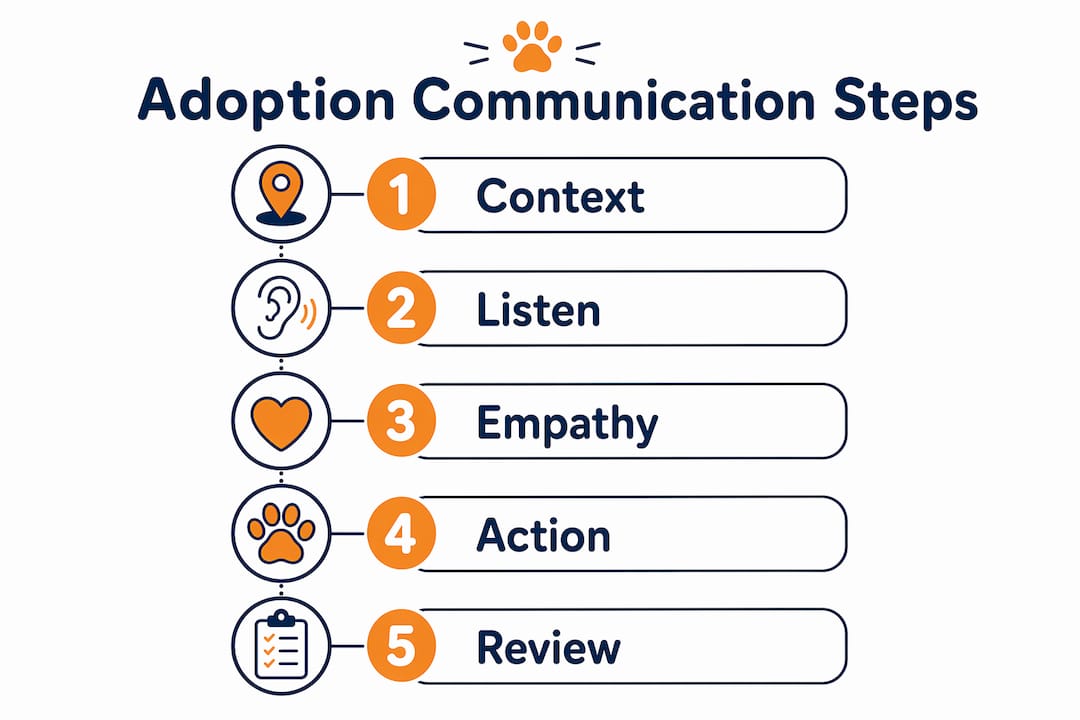
Practical frameworks give staff a repeatable structure for conversations, especially during high-stress moments like behavioral concerns or difficult match discussions. The CLEAR communication method is one of the most effective tools available. CLEAR stands for Context, Listen, Empathy, Action, and Review.
Here is how each step applies to adoption conversations:
- Context: Open by establishing the purpose of the conversation. “I wanted to check in about how Luna is adjusting in her first week.”
- Listen: Let the adopter speak first without interruption. Gather the full picture before offering advice.
- Empathy: Acknowledge their experience before problem-solving. “It sounds like the first few nights have been tough. That’s completely normal.”
- Action: Offer a specific, concrete next step. “Let’s try crating her for two-hour intervals and see if that reduces the anxiety.”
- Review: Schedule a follow-up. “Can we check in again on Thursday to see how that’s going?”
Behavioral checklists are a second tool that dramatically improves post-adoption communication. Behavioral checklists help adopters track adjustment signs like pacing, hiding, or appetite changes in the first days after adoption. When adopters have a structured way to observe and record their pet’s behavior, they report concerns earlier and with more useful detail.
Interrogation vs. conversation: a direct comparison
| Approach | Interrogation Style | Conversational Style |
|---|---|---|
| Opening question | “Do you have experience with dogs?” | “Tell me about your history with pets.” |
| Concern handling | “That could be a problem.” | “Let’s talk through how that might work.” |
| Home environment | “Do you have a fenced yard?” | “What does your outdoor space look like?” |
| Follow-up | No scheduled check-in | Review call set before adoption is finalized |
| Outcome | Adopter feels screened | Adopter feels supported |
Pro Tip: Print the CLEAR framework on a laminated card and keep it at every adoption counselor’s desk. New volunteers especially benefit from having a visible reference during their first few weeks of conversations.
Step-by-step guide to initial contact through post-adoption follow-up
Timing and structure matter as much as tone. A well-intentioned shelter that takes five days to respond to an inquiry loses adopters to other options. Responding within two business days is the standard for maintaining adoption momentum. That window keeps the adopter’s interest high and signals that your organization is attentive.
Here is a step-by-step communication sequence that works:
- Day 1: Send a warm acknowledgment email within 24 hours of receiving an inquiry. Keep the form short and welcoming. Avoid front-loading paperwork.
- Day 2: Schedule a phone or video call to gather in-depth information conversationally. This is where open-ended questions do the most work.
- Day 3–5: Conduct the call. Use the CLEAR framework to guide the conversation. Match the pet’s personality to the adopter’s lifestyle, not just their checklist answers.
- Adoption day: Provide a behavioral checklist and a written list of emergency contacts. Walk the adopter through what the first 48 hours typically look like.
- Week 1 check-in: Call or text within 5–7 days. Ask open-ended questions: “How has the first week felt for your family?”
- Week 2–3 follow-up: A second check-in during this window catches most adjustment issues before they become return triggers.
The table below shows common follow-up mistakes and what to do instead:
| Common Mistake | Better Practice |
|---|---|
| No follow-up after adoption | Schedule check-ins on adoption day |
| Asking “Is everything okay?” | Ask “What’s been the biggest surprise so far?” |
| Waiting for adopter to report problems | Proactively reach out during weeks 1–3 |
| Vague advice on behavior issues | Request specific dates and triggers for each concern |
You can also review the full pet adoption workflow for a detailed breakdown of each stage from inquiry to post-placement support.
Why plain language builds more adopter confidence than jargon
Dense industry jargon alienates prospective adopters and creates confusion at exactly the moment when clarity matters most. Shelter staff often use terms like “resource guarding,” “threshold reactivity,” or “barrier frustration” without realizing these phrases mean nothing to most adopters. Transparency is non-negotiable, but the language you use to deliver it determines whether adopters feel informed or overwhelmed.
The Animal Farm Foundation draws a clear line between marketing language and counseling language. Marketing, meaning social media posts and adoption bios, should attract interest without overwhelming readers. Counseling, meaning in-person or phone conversations, is where full behavioral histories belong. Mixing these two functions confuses adopters and can either scare them off a good match or set unrealistic expectations.
Practical language swaps that work:
- “Resource guarding” becomes “She prefers to eat in a quiet space away from other pets.”
- “Barrier frustration” becomes “He gets excited and vocal when he can see dogs through a fence.”
- “Threshold reactivity” becomes “She needs a calm introduction to new dogs rather than a face-to-face greeting.”
One more technique: replace “but” with “and” when discussing a pet’s challenges. “She’s great with kids, but she needs a slow introduction to strangers” sounds like a warning. “She’s great with kids, and she does best when new people give her a moment to approach on her own terms” sounds like a description of a dog worth meeting.
From screening to welcoming: what i’ve learned about adopter communication
The biggest shift I have seen in shelter communication is not a new tool or a better form. It is a change in how staff think about their role. When a team sees itself as a screening committee, every conversation becomes a test the adopter might fail. When that same team sees itself as a matchmaking and support service, every conversation becomes a collaboration.
Role-playing is the fastest way to make that shift real. Shelters that invest even one hour per month in staff role-playing exercises see measurable changes in how volunteers handle difficult conversations. The staff member who used to say “that could be a problem” starts saying “let’s figure out how that would work.” That is not a small change. It is the difference between an adoption that happens and one that falls apart.
Post-adoption support is where most shelters underinvest. The first two to three weeks after placement are the highest-risk period for returns. A single proactive check-in call during that window can resolve a concern that would otherwise become a return. Adopters who hear from you first feel supported. Adopters who have to reach out first often feel like they are reporting a failure.
The long view matters here. Adopters who have a positive experience become repeat adopters, donors, and advocates. Treat every adopter as a lifelong partner in your mission, not a transaction to complete.
— Taylor
How Greenfieldpups supports better adoption conversations
Greenfieldpups is built around the belief that better information leads to better placements. Whether you are a shelter volunteer looking to sharpen your communication approach or a potential adopter trying to understand what to expect, Greenfieldpups offers practical resources that make the process clearer for everyone involved.
From guides on ethical adoption practices to detailed breakdowns of what responsible pet ownership looks like, Greenfieldpups gives shelter staff and adopters a shared foundation of knowledge. Explore the adoption benefits guide to reinforce the positive messaging you use with potential adopters every day. When both sides of the adoption conversation are well-informed, placements stick and pets thrive.
Key takeaways
Effective adopter communication requires a consistent shift from screening to supporting, using structured frameworks and plain language at every stage of the process.
| Point | Details |
|---|---|
| Use open-ended questions | Replace yes/no questions with “how,” “tell me,” and “what” prompts to invite honest conversation. |
| Apply the 10-4 greeting rule | Smile within 10 feet and acknowledge verbally within 4 feet to set a welcoming tone immediately. |
| Follow the CLEAR framework | Use Context, Listen, Empathy, Action, and Review to guide every adoption and follow-up conversation. |
| Respond within two business days | Timely responses to inquiries maintain momentum and signal that your shelter is attentive and organized. |
| Replace jargon with plain language | Translate behavioral terms into everyday descriptions so adopters feel informed rather than overwhelmed. |
FAQ
What are open-ended questions in pet adoption?
Open-ended questions use prompts like “tell me,” “how,” “what,” and “when” to invite adopters to share freely rather than answer yes or no. They reduce defensiveness and give staff far more useful information about an adopter’s lifestyle and expectations.
How soon should shelters follow up after adoption?
Shelters should conduct a first check-in within 5–7 days of adoption and a second follow-up during weeks 2–3. That window covers the highest-risk adjustment period and catches most behavioral concerns before they lead to a return.
What is the CLEAR communication method?
CLEAR stands for Context, Listen, Empathy, Action, and Review. It is a structured conversation framework that helps shelter staff address adopter concerns empathetically and schedule concrete follow-up steps.
How do you avoid alienating adopters during screening?
Replace application-heavy screening with a brief initial form followed by a phone or video call. Conversational intake gathers the same information in a format that feels supportive rather than evaluative.
Why should shelters avoid jargon in adoption communications?
Industry terms like “resource guarding” or “threshold reactivity” confuse most adopters and can make a manageable pet sound intimidating. Plain-language descriptions of the same behaviors keep adopters informed and confident rather than discouraged.
Leave a Comment