


How to Screen Puppy Buyers: A Breeder’s 2026 Guide
Screening puppy buyers is the process of evaluating prospective owners through written applications, conversations, and assessments to confirm they can provide responsible, lifelong care. Done well, it protects your puppies, your reputation, and your peace of mind. The American Kennel Club recommends discussing vet appointments and early care plans as part of responsible buyer evaluation, especially with first-time owners who may face waitlists for veterinary care. Tools like BreedTools and BreedTracker have formalized this process into repeatable, multi-stage frameworks that any breeder can follow.
How to screen puppy buyers: the foundational elements
Effective screening starts with a structured written application before any phone call or visit. BreedTools recommends covering five core areas in that application: living situation, prior dog ownership experience, veterinary readiness, reasons for choosing the breed, and training and socialization plans. Each area reveals a different dimension of buyer preparedness.
The application serves as your first filter. Serious buyers complete it carefully. Buyers who skip questions, give one-word answers, or push back on the form itself often signal low commitment before you’ve spent a minute on the phone.
Keep the application clear and direct. Overly long or invasive forms scare off good buyers who have nothing to hide but value their privacy. Aim for 10 to 15 focused questions that a buyer can answer in under 20 minutes.
- Living situation: Do they own or rent? Is there a yard? Are there children or other pets?
- Experience: Have they owned this breed before? What happened to previous dogs?
- Vet readiness: Do they have a vet selected? Are they aware of breed-specific health needs?
- Breed motivation: Why this breed specifically? Do they understand its energy level and grooming needs?
- Training plans: Do they plan to attend puppy classes? Who is the primary caregiver?
Pro Tip: Sequence your screening to save time. Review the written application first, then schedule a call only with buyers who pass your baseline criteria. This protects your time and signals to serious buyers that you run a professional operation.
How do you conduct interviews to evaluate potential buyers?
The phone or video call is not an interrogation. BreedTracker advises treating it as a walk-through of the application, a chance to clarify answers and discuss your expectations as a breeder. That framing changes the entire tone of the conversation.
Use the call to cover four areas in order:
- Clarify application answers. Ask follow-up questions on anything vague. “You mentioned you rent. Has your landlord approved a dog?” is more useful than a yes/no question on the form.
- Discuss contract terms. Cover spay/neuter policies, return policies, and your expectation of post-sale updates. Buyers who resist these terms at this stage rarely improve after the sale.
- Ask the diagnostic question. BreedTracker identifies “What would you do if you could no longer keep the dog?” as the single most revealing question in the entire process. The correct answer is to contact the breeder first. Any other answer reveals a gap in long-term commitment.
- Gauge buyer engagement. Do they ask questions about your health testing, your socialization protocols, or the puppy’s temperament? Buyers who ask nothing often care only about price or availability.
BreedTools emphasizes that conversation tone matters as much as content. A buyer who feels interrogated shuts down. A buyer who feels respected opens up and gives you far more useful information.
Pro Tip: Use the call to educate, not just evaluate. Explaining your health testing process or your socialization schedule builds rapport and filters out buyers who are not genuinely interested in what you do.

What are the red flags and green flags in buyer screening?
Not all screening signals carry equal weight. BreedTracker recommends categorizing and scoring buyer answers so your decisions are defensible and consistent across applicants.
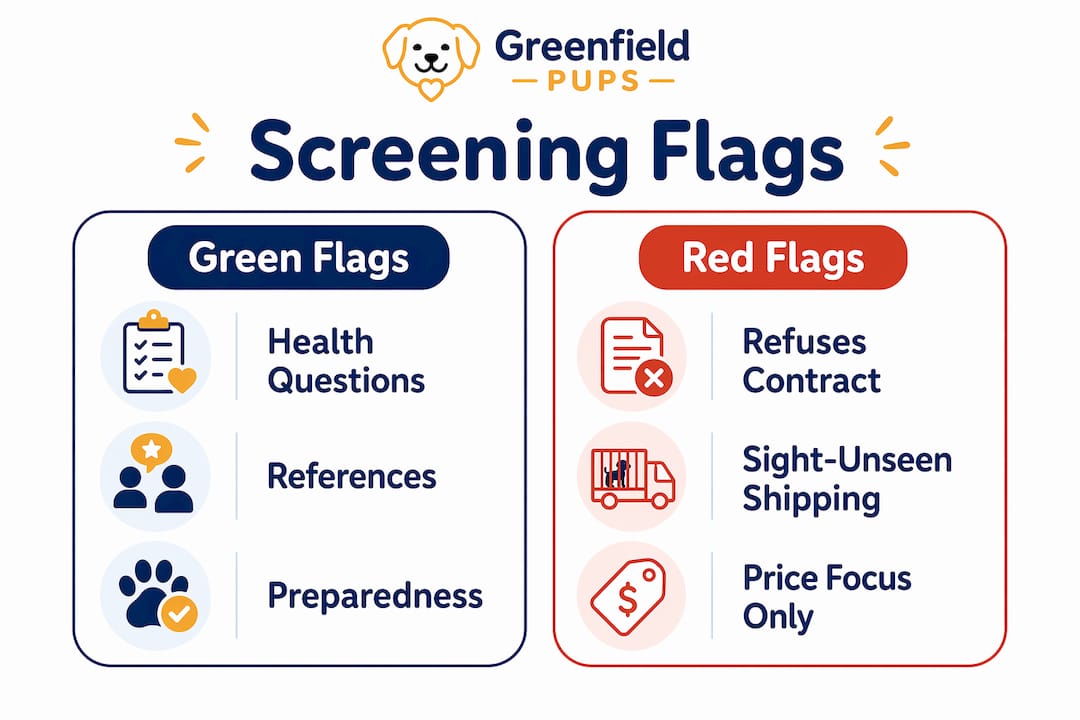
Red flags to document immediately:
- Buyer focuses exclusively on price and pushes for discounts before asking a single question about the puppy
- Requests shipping without any in-person or video meeting
- Refuses to sign a contract or dismisses health guarantees as unnecessary
- Shows no knowledge of the breed’s health issues or energy requirements
- Cannot provide a personal or veterinary reference
Green flags that indicate a serious buyer:
- Asks specifically about your health testing results and what certifications the parent dogs carry
- Demonstrates prior research on breed characteristics, including known health risks
- Volunteers information about their living situation and family without being prompted
- Expresses willingness to sign a contract and welcomes the return policy as reassurance
| Behavior | Signal | Weight |
|---|---|---|
| Asks about health testing | Green flag | High |
| Requests sight-unseen shipping | Red flag | High |
| Refuses contract | Red flag | Critical |
| Researched breed beforehand | Green flag | High |
| Focuses only on price | Red flag | Medium |
| Asks about socialization plans | Green flag | Medium |
Pro Tip: Trust your instincts, but back every decision with documented criteria. If you decline a buyer, your notes should explain why. This protects you legally and keeps your process consistent.
Are home visits necessary, or do alternatives work just as well?
Home visits are the most controversial part of screening potential puppy owners. Many serious, qualified buyers object to them on privacy grounds. Refusing a home visit does not make someone a bad owner.
The Functional Dog Collaborative advises focusing any home check on safety-relevant factors, not personal taste. A fenced yard matters. The color of the kitchen does not. Framing the check around puppy welfare rather than lifestyle judgment makes it far more acceptable to buyers.
| Method | Pros | Cons |
|---|---|---|
| In-person home visit | Most thorough safety check | Privacy concerns, logistical barriers |
| Virtual video tour | Respects privacy, easy to schedule | Buyer controls what you see |
| Photo submission | Low friction, quick to complete | Limited context, easy to stage |
| Reference check | Reveals character and history | Time-consuming, references are self-selected |
For most placements, a safety-focused virtual tour combined with a strong reference check gives you enough information without alienating qualified buyers. Reserve in-person visits for high-energy breeds or buyers with young children, where physical environment matters most.
Be transparent about why you ask for any verification. Buyers who understand your reasoning almost always cooperate. Buyers who refuse even after a clear explanation give you useful information about their character.
What documentation and contracts protect both breeder and puppy?
A contract is not a formality. It is the clearest signal you send that you take your responsibility seriously. The Royal Kennel Club recommends verifiable paperwork from breeders, including health certificates for parent dogs and written contract terms that define both parties’ obligations.
Your contract should cover at minimum:
- Health guarantees: What conditions are covered, for how long, and what the buyer must do to claim them
- Return policy: A clear statement that you will take the dog back at any point in its life, no questions asked
- Spay/neuter requirements: If applicable, the timeline and your expectations for confirmation
- Post-sale updates: Your expectation of photos or check-ins at 6 months and 1 year
“Documentation and contract clarity are hallmarks of responsible breeders and reduce mismatch risks.” — Royal Kennel Club guidance on buyer-breeder agreements
Contracts also serve a communication function. A buyer who reads your contract before signing understands exactly what kind of breeder you are. That transparency builds trust and sets the tone for a long-term relationship. Breeders who use clear contract terms consistently report fewer post-sale disputes and more buyers who stay in touch.
Pro Tip: Send the contract before the final meeting, not at pickup. Buyers who have time to read it carefully ask better questions and commit more confidently.
Key Takeaways
Screening puppy buyers requires a structured, multi-stage process that combines a written application, a follow-up conversation, red and green flag assessment, and clear contract documentation to secure responsible, lifelong placements.
| Point | Details |
|---|---|
| Start with a written application | Use 10–15 focused questions covering living situation, experience, vet readiness, and training plans. |
| Follow up with a call or video chat | Clarify application answers, discuss contract terms, and ask the diagnostic “what if” question. |
| Document red and green flags | Score buyer behaviors consistently so every placement decision is defensible and fair. |
| Offer home visit alternatives | Virtual tours and photo submissions respect privacy while still confirming safety-relevant conditions. |
| Use contracts as communication tools | Send contracts early so buyers understand your standards before the final meeting. |
What I’ve learned from watching breeders get this wrong
Most breeders who struggle with placements are not screening too little. They are screening inconsistently. They apply strict criteria to one buyer and waive them for the next because the second buyer seemed nicer on the phone. That inconsistency is where bad placements happen.
The multi-stage process works precisely because it forces you to evaluate the same criteria every time. A written application does not get charmed. A scoring system does not get tired at the end of a long call. When you build the process correctly, your gut instinct becomes a supplement to the system, not a replacement for it.
The other mistake I see constantly is treating screening as a one-way evaluation. Screening is a two-way process. The best buyers are also evaluating you. They want to know your health testing results, your return policy, and whether you will answer the phone six months after the sale. Breeders who treat the process as an interrogation lose good buyers to breeders who treat it as a conversation.
Privacy objections to home visits are real and legitimate. I have seen excellent owners walk away from breeders who insisted on in-person visits. A virtual tour focused on fencing, sleeping arrangements, and hazard removal gives you everything you actually need. Save the in-person visit for cases where the breed or the buyer’s circumstances genuinely require it.
The goal of screening is not to find a perfect buyer. It is to find a prepared one. Preparedness for lifelong ownership looks like a buyer who has a vet selected, has researched the breed, and understands that you are a resource they can call for the dog’s entire life. That buyer exists in every market. A good screening process finds them reliably.
— Taylor
How Greenfieldpups helps breeders reach serious buyers
Greenfieldpups connects responsible breeders with buyers who are actively searching for specific breeds across the United States. The platform is built for breeders who take placement seriously, offering listing tools that attract informed, committed buyers rather than impulse shoppers.
Breeders using Greenfieldpups can pair their listings with the platform’s educational resources on ethical breeding practices and breeder roles and responsibilities to set clear expectations before the first inquiry arrives. A well-crafted listing on a trusted marketplace is the first stage of your screening process. It signals your standards before a single application is submitted. Visit Greenfieldpups to list your available puppies and reach buyers who are ready to meet your criteria.
FAQ
What is the most important puppy buyer interview question?
BreedTracker identifies “What would you do if you could no longer keep the dog?” as the most diagnostic question in buyer screening. The correct answer is to contact the breeder first.
Should I require a home visit before placing a puppy?
Home visits are not required. The Functional Dog Collaborative advises offering virtual tours or photo submissions as privacy-respecting alternatives that still confirm safety-relevant conditions.
What are the biggest red flags when screening dog buyers?
BreedTools lists refusing contracts, requesting sight-unseen shipping, focusing only on price, and showing no knowledge of breed health needs as the most serious red flags in buyer screening.
How many stages should a puppy buyer screening process include?
A complete process includes at least three stages: a written application, a phone or video follow-up call, and a contract review before placement. Some breeders add a home or virtual visit as a fourth stage for high-energy breeds.
What should a breeder contract include?
A breeder contract should cover health guarantees, a lifetime return policy, spay/neuter requirements if applicable, and post-sale update expectations. The Royal Kennel Club recommends verifiable paperwork alongside written contract terms to prevent mismatches.
Leave a Comment