


What Is a Purebred Dog? Definition, Traits, and Facts
A purebred dog is defined as one whose ancestry is officially documented through at least four generations of recorded pedigree within a recognized breed registry, such as the American Kennel Club (AKC) or the Royal Kennel Club. That definition matters more than most new dog owners realize. A dog can look exactly like a German Shepherd or a Golden Retriever and still not qualify as purebred under official standards. The distinction lies entirely in paperwork, not appearance. This article breaks down what purebred status actually means, why pedigree documentation is the gold standard, and what you need to know before buying or breeding.
What is a purebred dog, according to kennel clubs?
A purebred dog is a legal and administrative classification, not simply a genetic or appearance-based concept. The AKC defines a dog as purebred when it has four generations of recorded pedigree within an AKC-recognized breed, tracing lineage through registered parents, grandparents, and great-grandparents. That is the baseline requirement, and it is non-negotiable under AKC rules.
The Royal Kennel Club takes a similar but slightly different approach. Under its framework, a pedigree dog requires both parents to be registered in the same recognized breed. This means the emphasis falls on registered parentage rather than the full four-generation chain the AKC requires. The practical implication is that “purebred” is not a universal term with one fixed threshold. It depends on which registry you are working with.
What both organizations agree on is this: official purebred status depends on registry documentation rather than phenotypical resemblance. A dog that looks like a purebred Labrador Retriever but lacks documented lineage is not a purebred Labrador Retriever in any official sense. Breed terminology gets conflated in casual conversation constantly, but the registries are precise about this distinction.
How pedigree documentation establishes purebred status
Pedigree documentation is the paper trail that proves a dog’s ancestry meets registry standards. Without it, no registry will certify a dog as purebred, regardless of how the animal looks or what a DNA test suggests. Here is how the documentation process works in practice:
- Both parents must be registered. Before a puppy can be registered as purebred with the AKC or Royal Kennel Club, both parents must already hold active registrations within the same recognized breed.
- Lineage must be traceable across multiple generations. The AKC requires four generations of recorded ancestry. Each generation in the chain must consist of dogs registered in the same breed.
- Breeders submit litter registration applications. After a litter is born, the breeder files a litter registration with the relevant kennel club. Individual puppies are then registered from that litter record.
- The pedigree certificate is issued. Once registration is confirmed, the owner receives a pedigree certificate listing the dog’s full ancestry. This document is what distinguishes a registered purebred from an unregistered dog of similar appearance.
Pedigree records are not the same as appearance standards, and they are not the same as genetic testing. A pedigree traces administrative lineage through registered dogs. Appearance standards describe what a breed should look like. Genetic testing estimates biological ancestry. These are three separate systems, and only the pedigree record confers official purebred status.
Pro Tip: When buying a purebred puppy, always ask to see the parents’ registration certificates before the litter registration paperwork. If a breeder cannot produce both, the puppy’s purebred status cannot be verified through official channels.
Understanding ethical breeder practices is the fastest way to learn what documentation a legitimate seller should always have on hand.
Can a DNA test confirm a dog is purebred?
DNA breed-heritage tests cannot confirm a direct one-to-one match to an official breed registry. This is one of the most persistent misconceptions in dog ownership, and the AKC has addressed it directly. DNA tests work by comparing a dog’s genetic markers against reference panels of known breeds. They produce statistical estimates of ancestry, not registry confirmations.
The AKC explicitly states that breed-heritage tests are complementary evidence only, not a substitute for documented pedigrees. The reason is structural. Breed definitions are dynamic classifications maintained by breed clubs, not fixed genetic profiles. A breed’s genetic signature changes over time as breeders make selective choices. A DNA test captures a statistical snapshot, not a registry-valid confirmation.
Consider what this means in practice:
- A dog with 98% Labrador Retriever DNA according to a commercial test may still not qualify as a registered purebred if its parents were not AKC-registered.
- A dog with 85% Border Collie ancestry on a DNA panel could have that result because of shared genetic markers with related herding breeds, not because of direct Border Collie lineage.
- Two dogs with identical DNA test results can have completely different registration statuses depending on their documented ancestry.
“Breed-heritage DNA tests are optimized for similarity detection across multiple breeds, not for registry eligibility confirmation, which requires documented lineage.” — American Kennel Club
The takeaway is straightforward. DNA tests are useful for curiosity, health screening, and supplementary information. They are not a replacement for pedigree paperwork when purebred status is the question on the table.
Characteristics of purebred dogs: what to expect
Purebred dogs have predictable traits in size, coat, and temperament because breed standards preserved through pedigree breeding define what each generation should look like and how it should behave. This predictability is one of the primary reasons people choose purebreds over mixed breeds.

Breed standards are formal documents maintained by breed clubs and recognized by registries like the AKC. They specify acceptable height and weight ranges, coat type and color, head shape, ear set, tail carriage, and temperament descriptors. A Golden Retriever standard, for example, calls for a friendly, reliable, and trustworthy temperament alongside a dense, water-repellent outer coat. Breeders working within the standard select for these traits generation after generation.
The practical benefits for owners are significant:
- Size predictability. You know within a narrow range how large your puppy will grow. A Cavalier King Charles Spaniel will reach 12 to 13 inches at the shoulder. A Great Dane will reach 28 to 32 inches. Mixed breeds offer no such guarantee.
- Temperament consistency. Breeds like the Border Collie are known for high energy and herding instincts. Breeds like the Basset Hound are known for low energy and a calm disposition. These tendencies are reliable enough to plan around.
- Exercise and care requirements. A Siberian Husky needs significantly more daily exercise than a Shih Tzu. Knowing the breed means knowing the commitment before the dog comes home.
- Health screening opportunities. Ethical breeders who follow registry standards invest in genetic health screening and early socialization, giving puppies a stronger foundation for adult health.
That last point matters. Responsible breeding is not just about producing dogs that meet a visual standard. It is about producing dogs that are physically sound and behaviorally stable. Learning about responsible dog breeding practices helps you understand what separates a quality breeder from one cutting corners.
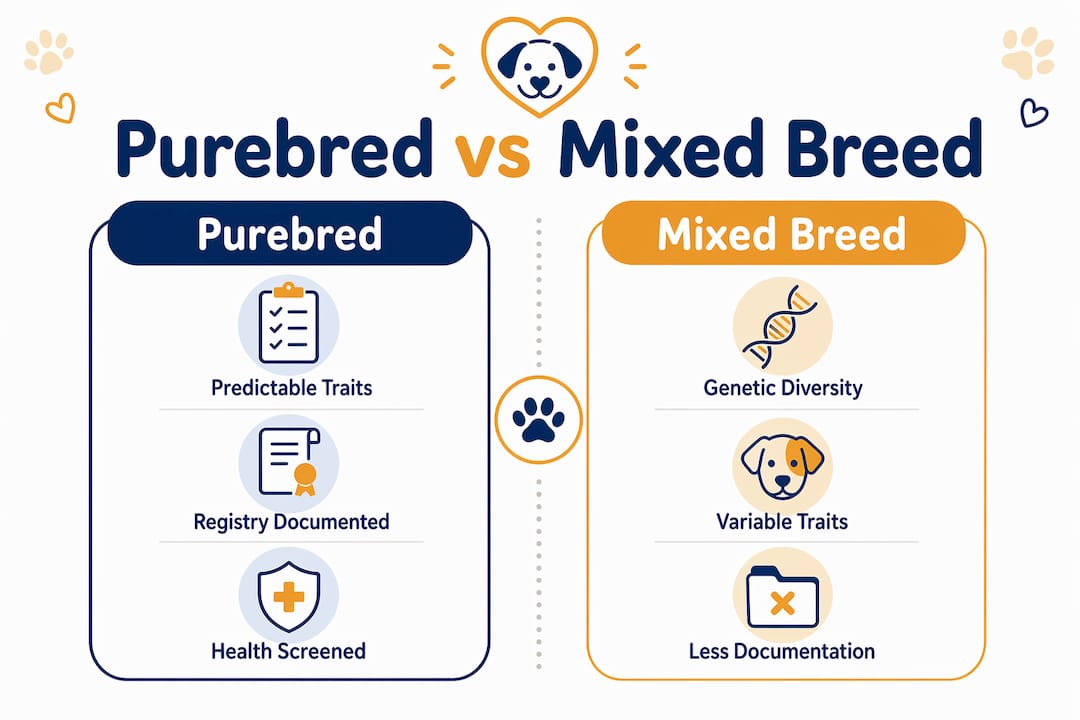
Purebred vs. mixed breed: what you actually need to know
The purebred vs. mixed breed debate generates more heat than it deserves. Both have real advantages, and the right choice depends entirely on what you need from a dog.
| Factor | Purebred dogs | Mixed breed dogs |
|---|---|---|
| Trait predictability | High. Breed standards define expected size, coat, and temperament. | Low to moderate. Traits depend on which breeds are present and in what proportion. |
| Health considerations | Breed-specific conditions are known and screenable. Ethical breeders test for them. | May benefit from hybrid vigor, but unknown ancestry makes health screening harder. |
| Registration and pedigree | Eligible for AKC or Royal Kennel Club registration with documented lineage. | Not eligible for breed registry registration regardless of appearance. |
| Cost | Typically higher upfront from reputable breeders. | Often lower, especially from shelters. |
| Availability | Breed-specific breeders, breed rescues, and platforms like Greenfieldpups. | Shelters, rescues, and general adoption platforms. |
The “hybrid vigor” argument for mixed breeds, the idea that genetic diversity automatically produces healthier dogs, is real but overstated. Mixed breeds can still inherit health problems from both parent breeds. Purebreds bred by ethical, health-testing breeders often have better documented health histories than mixed breeds of unknown origin.
Pro Tip: If you want a purebred dog but are concerned about health risks, ask the breeder for OFA (Orthopedic Foundation for Animals) or PennHIP certifications for the parents. These are concrete health screening records, not just verbal assurances.
The decision between a purebred and a mixed breed is not a question of which is objectively better. It is a question of which fits your lifestyle, expectations, and capacity to meet the dog’s needs. Understanding how to choose a responsible breeder is the practical next step once you have decided on a purebred.
Key takeaways
A purebred dog’s status is determined entirely by documented pedigree through a recognized registry, not by appearance, DNA results, or price.
| Point | Details |
|---|---|
| Official definition | The AKC requires four generations of recorded pedigree; the Royal Kennel Club requires registered parents of the same breed. |
| Pedigree over DNA | DNA tests estimate ancestry statistically and cannot confirm registry-valid purebred status. |
| Trait predictability | Breed standards give purebred owners reliable expectations for size, temperament, and care needs. |
| Health screening | Ethical breeders test parent dogs for breed-specific conditions before breeding, reducing known health risks. |
| Purebred vs. mixed breed | Neither is universally superior. Purebreds offer predictability; mixed breeds offer variety. The right choice depends on your needs. |
Why documented pedigree matters more than most buyers realize
I have seen buyers walk away from a $2,000 “purebred” puppy with nothing but a DNA test printout as proof of lineage. That is not documentation. That is a marketing tool dressed up as evidence.
The paperwork question is where most buyers get tripped up. A dog can be sold as a purebred Golden Retriever, look exactly like one, and even test as predominantly Golden Retriever on a commercial DNA panel. Without AKC registration papers tracing back through registered parents and grandparents, that dog is not a registered purebred. You are paying a purebred price for an unregistered dog. That matters if you ever want to breed, show, or sell the dog with verified lineage.
What I have found after years of watching buyers navigate this space is that the breeders who resist showing paperwork are almost always the ones who do not have it. A reputable breeder is proud of their pedigree records. They will show you the parents’ registration certificates, the health testing results, and the litter registration without being asked twice. If a breeder deflects those questions or substitutes a DNA test for actual registry documents, walk away.
The other thing worth saying plainly: supporting ethical breeders who follow registry standards is not just about getting a piece of paper. It is about supporting a system that incentivizes health testing, proper socialization, and breed preservation. When you buy from a breeder who cuts corners on documentation, you fund that model. When you buy from one who does it right, you fund the better one.
— Taylor
Find reputable purebred breeders on Greenfieldpups
Greenfieldpups connects buyers with breeders across the United States who list dogs with verifiable credentials and documented lineage. Whether you are searching for a specific breed or comparing options across multiple breeds, the platform gives you the tools to search by breed, location, and breeder type.

Before you commit to any purchase, use Greenfieldpups to research breeder types and standards so you know exactly what questions to ask and what documentation to expect. The platform also publishes resources on breeder ethics and responsibilities to help you make a confident, informed decision. Start your search at Greenfieldpups and find a breeder who stands behind their dogs with real paperwork.
FAQ
What defines a purebred dog officially?
A purebred dog is officially defined by documented pedigree through a recognized registry. The AKC requires four generations of recorded lineage, while the Royal Kennel Club requires both parents to be registered in the same breed.
Can a DNA test prove a dog is purebred?
No. DNA tests estimate breed ancestry through statistical similarity but cannot confirm registry-valid purebred status. The AKC treats breed-heritage DNA tests as complementary evidence only, not a substitute for pedigree documentation.
How do I identify a purebred dog when buying?
Ask the breeder for the parents’ registration certificates and the litter registration paperwork from a recognized kennel club such as the AKC. Appearance and DNA results alone are not sufficient proof of purebred status.
Are purebred dogs healthier than mixed breeds?
Not automatically. Purebred dogs from ethical breeders who conduct health screening have documented health histories that reduce known breed-specific risks. Mixed breeds may benefit from genetic diversity, but unknown ancestry makes health screening harder to conduct.
Do all purebred dogs need to be registered?
Registration is not legally required for ownership, but it is required to officially verify purebred status, participate in AKC events, or breed dogs with documented lineage. Without registration, a dog’s purebred status cannot be confirmed through official channels.
Leave a Comment