


What Is Breed Certification? A Guide for Dog Buyers
Breed certification is an official process that evaluates dogs through health testing, parentage verification, and registry documentation to confirm they meet breed-specific standards. The term covers three distinct credential types: health certifications from organizations like OFA and CHIC, parentage verification through AKC DNA profiling, and pedigree registration through bodies like the American Kennel Club. Prospective buyers and breeders who treat these as interchangeable make costly mistakes. Understanding what each credential actually measures is the first step toward making a genuinely informed decision.
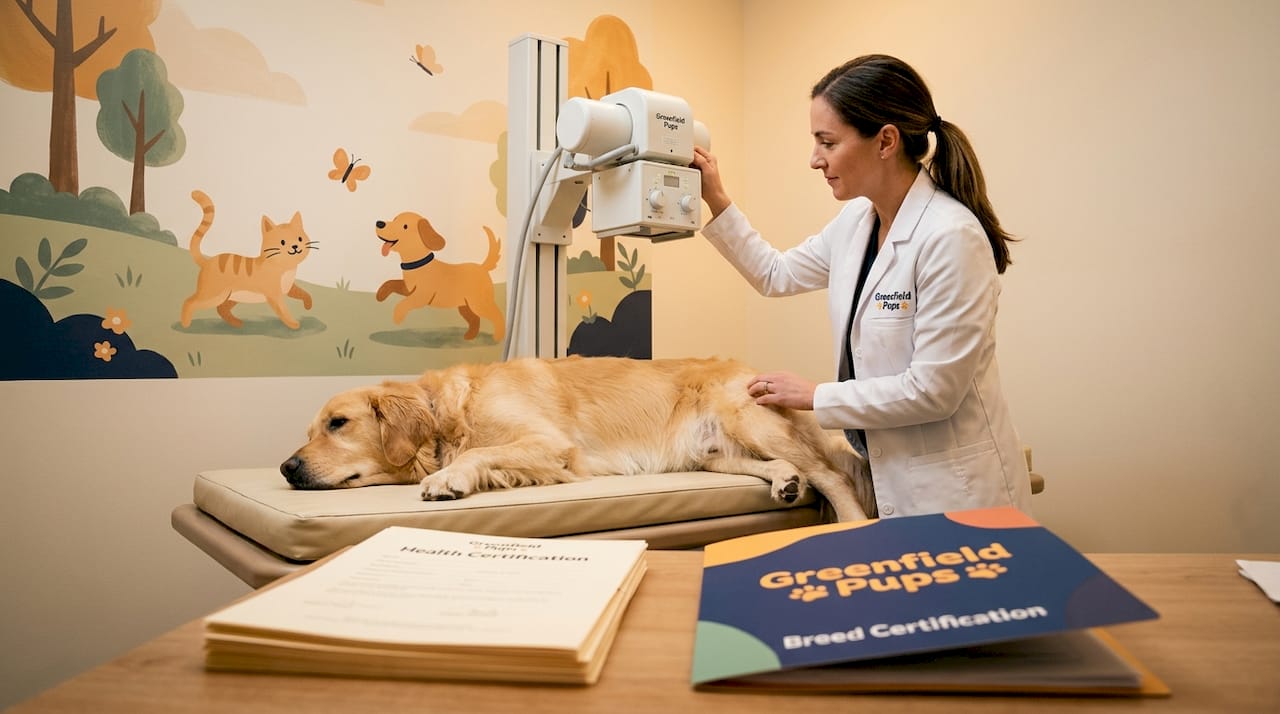
What is breed certification, and what does it actually cover?
Breed certification is not a single test or a single document. Breed certification involves registry-driven evaluations that span health testing, parentage verification, and breed club documentation. Each component addresses a different risk and serves a different purpose in responsible breeding.
The three core pillars are:
- Health certification: Evaluations by organizations like OFA (Orthopedic Foundation for Animals) and CHIC (Canine Health Information Center) that screen for hereditary and orthopedic conditions
- Parentage verification: AKC DNA profiling that confirms biological relationships between a dog and its registered parents
- Pedigree registration: Documentation of a dog’s lineage through a recognized registry like the AKC, which establishes breed identity and ancestry records
Because the phrase “breed certification” is loosely used across the industry, verifying which credential is being referenced is the safest approach for any buyer or breeder. A breeder who says their dog is “certified” may mean any one of these three things, or a combination of all of them.
What health certifications are included in breed certification?
Health certification is the most medically significant component of the breed certification process. OFA evaluates hereditary and orthopedic diseases, including hip dysplasia, elbow dysplasia, cardiac conditions, eye disorders, and patellar luxation. CHIC, which operates in partnership with OFA and breed-specific parent clubs, certifies that a dog has completed all recommended health tests for its breed and that results are publicly posted.
The critical distinction with CHIC is one most buyers miss entirely. CHIC certification means testing transparency, not guaranteed clear results. A dog can earn a CHIC number even if some results are abnormal, as long as all required tests were completed and results made public. This design prioritizes honest disclosure over favorable outcomes, which is actually more useful for breeding decisions than a simple pass/fail label.
Common health tests included in breed certification requirements are:
- Hip and elbow evaluations (OFA radiograph review)
- Cardiac exams performed by a board-certified cardiologist
- Ophthalmologist eye exams
- Patella evaluations
- DNA-based health panels for breed-specific genetic conditions
Pro Tip: When reviewing a dog’s health certifications, look up the actual OFA results at ofa.org rather than relying on what a breeder tells you. The database is public, and the raw results tell a more complete story than any certificate.
Health certifications rely on specialist veterinary testing combined with independent evaluation by breed organizations. Breeders do not self-certify. Results are submitted to and interpreted by specific organizations before any official certification is issued, which maintains objectivity and protects the credibility of the process.
| Test type | Evaluating body | What it screens for |
|---|---|---|
| Hip/elbow radiographs | OFA | Dysplasia and joint malformation |
| Cardiac exam | OFA / Cardiologist | Inherited heart conditions |
| Eye exam | OFA / CAER | Hereditary eye diseases |
| DNA health panel | OFA / Breed club labs | Breed-specific genetic mutations |
| CHIC number | CHIC / OFA | Completion of all breed-required tests |
How does parentage verification fit into breed certification?
Parentage verification confirms that a dog’s registered parents are its actual biological parents. AKC DNA profiling is the only AKC-approved method for this, using 201 genetic markers to confirm biological relationships. It is required for certain registration conditions, including multi-sire litters and dogs used frequently at stud.
What AKC DNA profiling does not do is equally important to understand:
- It does not assess breed purity or confirm a dog is purebred
- It does not evaluate genetic health or disease risk
- It does not replace pedigree documentation or health testing
Breed heritage DNA tests estimate ancestry through genetic markers but cannot confirm purebred status or match directly to official registries. The AKC recognizes purebreds by documented pedigrees, not genetic tests. This distinction matters because many buyers conflate consumer DNA tests with official parentage verification, and they are fundamentally different tools.
The AKC DNA process typically takes 6 to 12 weeks from submission to result. That timeline has real implications for breeders registering litters, particularly in multi-sire scenarios where parentage must be confirmed before puppies can be individually registered.
Pro Tip: If you are buying a puppy from a multi-sire litter, ask the breeder for the AKC DNA confirmation before finalizing the purchase. Without it, the puppy’s parentage is unverified, regardless of what the registration papers say.
Mandatory DNA profiling for frequently used sires and imported stock prevents parentage misattribution and maintains registry credibility. This is especially relevant in high-volume breeding programs where record errors are more likely.
What are breed standards and registration certifications?
Breed standards are written descriptions of the ideal physical and temperamental characteristics for a recognized breed, maintained by registries like the AKC. They define everything from coat texture and ear set to gait and temperament. Breed standards serve as the benchmark against which dogs are evaluated in conformation shows and breeding programs.
AKC registration documents pedigree and provides registry status. It records a dog’s lineage going back multiple generations and confirms the dog’s parents were also registered. Registration is distinct from health certification. Both are components of responsible breeding, but they answer different questions.
| Document type | What it confirms | What it does not confirm |
|---|---|---|
| AKC registration | Lineage and registry status | Health, temperament, or genetic quality |
| OFA certification | Health test results | Pedigree or parentage |
| CHIC number | Test completion and transparency | Normal health results |
| AKC DNA profile | Biological parentage | Breed purity or health |
Understanding this table is the foundation of breed certification literacy. A dog can be AKC registered without any health testing. A dog can have OFA certifications without AKC registration. The most responsible breeders pursue all three pillars: registration, health certification, and parentage verification. Buyers who understand responsible dog breeding practices recognize that a single document is never the full picture.
Why is breed certification important for breeders and prospective owners?
Breed certification supports healthier dogs, more informed breeding choices, and greater accountability across the industry. Transparency through public records and rigorous testing informs better mate selection and produces healthier puppies over successive generations. This is not a theoretical benefit. It is the mechanism by which hereditary disease rates decline in well-managed breeds.
For prospective owners, the importance of breed certification comes down to four concrete protections:
- Health risk reduction: Certified parents with clear OFA results are statistically less likely to produce puppies with severe hereditary conditions
- Lineage accuracy: AKC DNA profiling confirms you are getting the dog you were promised, not a misrepresented litter
- Breeder accountability: Breeders who pursue certification are subject to external evaluation, not just their own claims
- Informed comparison: Public OFA and CHIC records let you compare breeders side by side on objective health data
“Breed certification programs like OFA and CHIC prioritize transparency and complete health testing, not just favorable results, to better guide breeding decisions.” — BreedTools
Breeding soundness evaluations include physical exams and genetic screening to assess health and heritable defects before breeding. Annual retesting for infections and imaging technologies are part of best practices for serious breeders. Understanding licensed dog breeder requirements in your state adds another layer of context, since licensing rules vary significantly by region.
How to get breed certified: the process and requirements
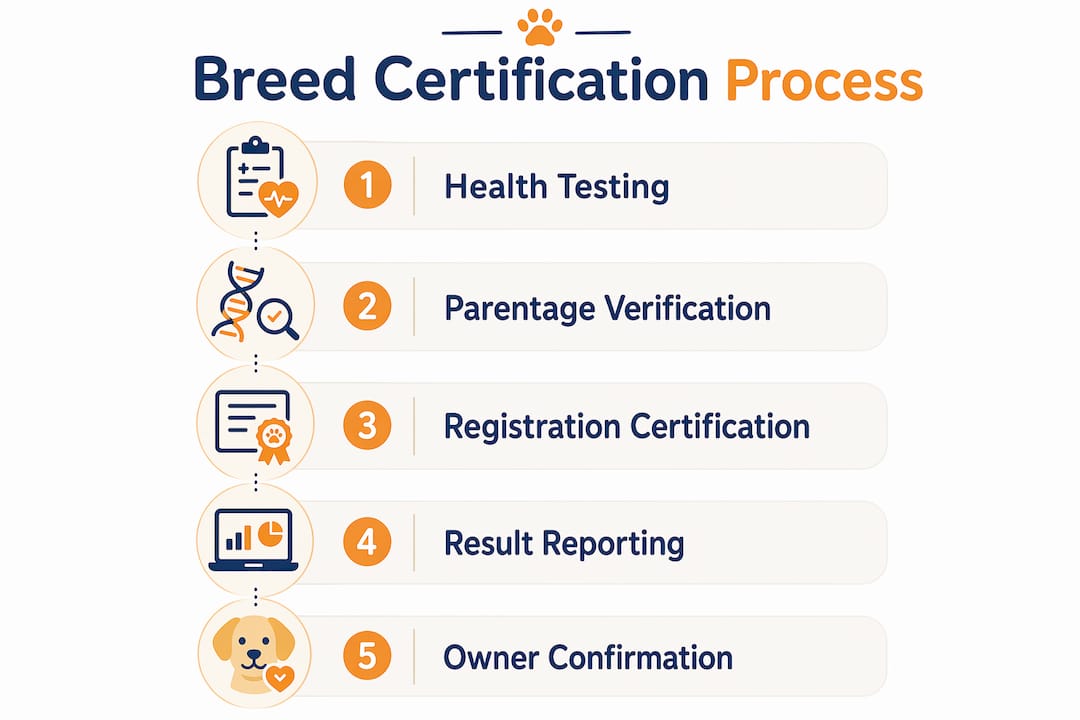
Getting a dog breed certified is a multi-step process that varies by breed and organization, but the general workflow follows a consistent structure.
- Identify breed-specific requirements. Each breed’s parent club publishes a list of recommended health tests. The CHIC website lists these requirements by breed, and OFA maintains a database of approved tests. Start here before scheduling any testing.
- Schedule specialist evaluations. Hip and elbow radiographs require OFA-approved veterinarians. Cardiac and eye exams require board-certified specialists. General practitioners cannot issue OFA certifications for most tests.
- Submit results to OFA or the relevant organization. Results go directly from the specialist or the breeder to OFA for evaluation. OFA issues the official certification after independent review. Breeders do not control or self-report results.
- Apply for a CHIC number. Once all breed-required tests are completed and results submitted, the breeder applies to CHIC for the dog’s number. The number is assigned only after OFA confirms all required tests are on file.
- Order AKC DNA testing if required. For stud dogs used frequently, multi-sire litters, or imported dogs, AKC DNA profiling must be ordered through the AKC. Kits are available through online litter and dog registrations.
- Maintain records and communicate clearly. Keep copies of all certificates, OFA reports, and DNA results. When listing or selling dogs, provide buyers with direct links to OFA records rather than photocopied certificates.
Pro Tip: Build a digital folder for each breeding dog that contains OFA result links, CHIC number confirmation, AKC registration papers, and DNA profile results. Sharing this folder with prospective buyers immediately signals the level of transparency that separates serious breeders from casual ones.
Understanding dog breeder ethics and responsibilities helps breeders see certification not as a bureaucratic hurdle but as a core professional standard. The process takes time and money, but it produces verifiable records that protect both the breeder’s reputation and the buyer’s investment.
Key takeaways
Breed certification is a three-part credential system covering health testing, parentage verification, and pedigree registration, and no single document substitutes for all three.
| Point | Details |
|---|---|
| Three distinct credential types | Health, parentage, and registration certifications each address different risks and cannot substitute for one another. |
| CHIC certifies transparency, not perfection | A CHIC number confirms all required tests were completed and results published, regardless of whether results were normal. |
| AKC DNA confirms parentage only | AKC DNA profiling verifies biological relationships using 201 markers but does not assess breed purity or health. |
| Public records beat paper certificates | OFA and CHIC results are publicly searchable, giving buyers objective data rather than breeder-controlled documents. |
| Process requires specialist involvement | Breeders cannot self-certify. Results are submitted to and evaluated by independent organizations before certification is issued. |
Why breed certification is more nuanced than most buyers realize
Most buyers walk into a breeder conversation expecting a simple yes or no on certification. After years of watching this play out, I can tell you that framing is the source of most disappointment and, sometimes, real harm.
A breeder can hand you a folder full of certificates and still be selling you a dog with a serious hereditary condition, because CHIC certification does not guarantee clear results. Conversely, a breeder with no certificates at all might be testing rigorously but simply not pursuing formal CHIC numbers, which is its own red flag for accountability. Neither extreme tells the full story.
What I have found actually works is asking for OFA database links, not paper copies. Paper can be altered or misrepresented. The OFA database cannot. If a breeder hesitates to provide a dog’s registered name so you can look up results yourself, that hesitation is the answer you needed.
The other thing worth saying plainly: breed certification is not uniformly enforced. Licensing and breed suitability regulations vary by region and may include health, genotype, phenotype, and behavior considerations. A certified dog in one state may not meet the standards expected in another context. Certification is a floor, not a ceiling. The best breeders treat it as a starting point for transparency, not a finish line.
If you are buying a dog, ask for the OFA number, look it up yourself, and read the actual results. If you are breeding, pursue certification not because it is required but because it is the only honest way to know what you are working with.
— Taylor
Find certified, ethical breeders on Greenfieldpups

Greenfieldpups connects prospective dog owners with breeders who take health testing, lineage verification, and breed standards seriously. The platform’s listings make it straightforward to browse dogs by breed and evaluate breeders based on the practices that matter. For buyers who want to understand what separates a responsible breeder from a casual one, Greenfieldpups has detailed guides covering types of dog breeders and what each type means for your buying experience. Whether you are searching for your first dog or expanding a breeding program, Greenfieldpups gives you the resources to make a decision grounded in facts, not marketing language.
FAQ
What does breed certification mean for a dog?
Breed certification refers to one or more credentials covering health testing, parentage verification, or pedigree registration. It is not a single document but a category of evaluations conducted by organizations like OFA, CHIC, and the AKC.
Is AKC registration the same as breed certification?
No. AKC registration documents a dog’s lineage and registry status but does not include health testing or parentage verification. Full breed certification requires health evaluations through OFA or CHIC in addition to registration.
Does a CHIC number mean a dog is healthy?
Not necessarily. A CHIC number confirms that all breed-required health tests were completed and results publicly posted, regardless of whether those results were normal. Always review the actual test results, not just the certification status.
How long does the breed certification process take?
Timelines vary by test type. OFA radiograph evaluations typically return results within a few weeks, while AKC DNA parentage verification takes 6 to 12 weeks. Breeders pursuing full CHIC certification must complete all breed-required tests before a number is assigned.
Can a consumer DNA test replace official breed certification?
No. Consumer breed heritage tests estimate ancestry but cannot confirm purebred status or match to official registries. The AKC recognizes purebreds through documented pedigrees, and parentage verification requires AKC DNA profiling specifically.
Leave a Comment